




Why the gap between academic rigor and real-world relevance is not just a translation problem — and what to do about it.
Introduction: The Resonance Gap
There is a quiet crisis running through business school research. Every year, thousands of rigorous studies are published in top academic journals. They pass peer review. They contribute to existing theory. They fill gaps in the literature. And then, for the most part, they are read by other academics — and no one else.
This is what might be called the resonance gap: the distance between research that satisfies the standards of academic knowledge production and research that actually registers with the organizations, managers, and practitioners it is presumably designed to help. Bridging this gap is not simply a matter of writing clearer abstracts or adding a section on “implications for practice.” The problem runs deeper than that — into the fundamental nature of what academic knowledge is, how it differs from practitioner knowledge, and what it would take to produce research that genuinely occupies the space where rigor and relevance converge.
That space has a name. It is the impact zone. And getting there requires a different way of thinking about how research problems are found, framed, and pursued.
Part I: The Bifurcated Market — Rigor Versus Relevance
A False Dichotomy With Real Consequences
For decades, the conversation about academic research in business schools has been organized around a tension: rigor versus relevance. On one side, rigorous research — theoretically grounded, methodologically sound, publishable in top peer-reviewed journals. On the other, relevant research — practically useful, accessible to managers, connected to the real problems organizations face. The implicit assumption is that you must choose, that moving toward one end of the spectrum means moving away from the other.
This is a false dichotomy, but its consequences are real. When researchers operate as though rigor and relevance are competing values, they tend to default toward rigor — because rigor is what the publication system rewards. The result is research that is technically excellent and practically inert. It contributes to the academic corpus. It advances theory. It fills gaps. And it fails to leave any discernible mark on the organizations its conclusions are about.
The path of least resistance for most academic researchers is to find a gap in the existing literature and fill it. This is not wrong, exactly — incremental theoretical progress matters, and the corpus of knowledge grows through exactly this kind of careful accretion. But it is insufficient if the goal is research that creates genuine impact beyond the academy. A gap in the literature is an academic artifact. It tells you what other academics have not yet studied. It tells you nothing about whether the question is important to anyone beyond other academics.
The Impact Zone
The impact zone is the conceptual space where rigorous academic research meets genuine practical relevance. It is not a compromise between the two — it is not research that sacrifices methodological standards for accessibility, nor research that sacrifices real-world significance for theoretical elegance. It is research that is both, simultaneously.
Getting into the impact zone requires reorienting the starting point of the research process. Instead of beginning with a gap in the literature and asking what do we not yet know academically?, the researcher begins with a real problem in the world and asks what does this problem need that rigorous inquiry can provide? The distinction sounds subtle. Its implications are profound.
Part II: The Epistemological Gap — More Than a Translation Problem
Scientific Knowledge Versus Practitioner Knowledge
At the heart of the rigor-relevance debate lies a question that is rarely asked directly: is the gap between academic and practitioner knowledge fundamentally a translation problem, or is it something deeper?
The translation view holds that scientific knowledge and practical knowledge are the same thing, just expressed differently. Academic researchers use technical jargon, complex statistical models, and abstract theoretical language. Practitioners think and communicate in concrete, contextual, experiential terms. On this view, the gap is one of communication — and closing it is a matter of simplification and plain-language restatement. Take the academic findings, strip out the jargon, render them in accessible terms, and practitioners will be able to use them.
This view is partially correct and substantially incomplete.
The deeper reality is that academic knowledge and practitioner knowledge differ not just in language but in epistemological character — in what they count as knowledge, what they value, and what they are designed to do. Understanding this difference is essential to understanding why the resonance gap is so persistent and why surface-level translation efforts consistently fall short.
What Academics Value: Generalization Over Context
The defining goal of academic knowledge production is generalization. Researchers try to identify patterns that are broader than any particular context — findings that hold across organizations, industries, cultures, and time periods. To achieve this, they systematically strip away contextual specificity. They control for variables that would complicate the picture. They model relationships in abstraction from the messy, entangled realities of actual organizations. They treat context as noise to be eliminated rather than signal to be understood.
This is not a methodological failure. It is the correct strategy for the goal researchers are pursuing. Generalizable knowledge — knowledge that transcends specific contexts and reveals underlying regularities — is enormously valuable. It builds the theoretical infrastructure that makes sense of diverse phenomena. It enables cumulative understanding in a way that purely contextual, experiential knowledge cannot.
But the price of generalizability is distance from context. And context is exactly what practitioners need.
What Practitioners Value: Experience and Context
Practitioners — managers, executives, consultants, operators — accumulate knowledge through experience. They learn what works in their specific industry, their specific organization, their specific competitive environment, at this particular moment in time. Their knowledge is contextually rich, experientially grounded, and immediately actionable. A practitioner who has navigated three organizational transformations carries knowledge that no journal article can fully capture — knowledge about how resistance forms and how it can be addressed, about which interventions work in which kinds of cultures, about the timing and sequencing of change.
This experiential, contextual knowledge has a kind of validity that academic knowledge often lacks. But it also has a kind of limitation that academic knowledge transcends: it does not generalize well. The practitioner who solved a particular problem in a particular organization cannot be certain whether their solution worked because of the general principles it embodied or because of the specific circumstances they happened to be in. They know the that without always being able to separate out the why.
Why Translation Alone Cannot Bridge the Gap
The epistemological gap between academic and practitioner knowledge means that no amount of translation can fully close it. Taking a theoretically sophisticated academic paper and simplifying the language will make it more readable. It will not make it more usable in the practical sense — it will not give the practitioner the contextual nuance, the experiential texture, the actionable specificity that they need to act in their particular situation.
By the same logic, all the effort that goes into writing richer “implications for practice” sections in academic papers is valuable but limited. It addresses the translation dimension of the gap. It does not address the epistemological dimension — the fundamental difference in what counts as useful knowledge in the two domains.
The only way to fully bridge the epistemological gap is to be embedded in practice — to work within the context, accumulate the experiential knowledge, and then bring both that experiential grounding and rigorous analytical tools to bear on the same problem. This is precisely the logic of engaged scholarship.
Part III: What Engaged Scholarship Actually Means
Van de Ven’s Diamond
The framework of engaged scholarship was developed by Andrew Van de Ven, a management scholar at the University of Minnesota, whose work on this topic has become a touchstone for researchers who want to produce knowledge that matters beyond the academy. At the center of his framework is a simple but powerful geometric model: the engaged scholarship diamond.
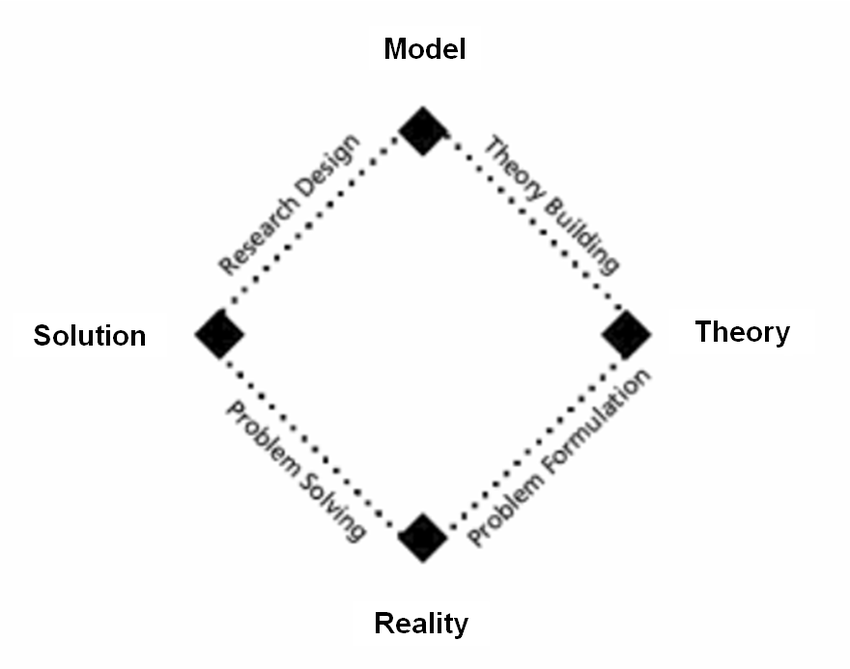
The diamond has four vertices, each representing a different phase of the research process. At the top are problem formulation and problem solving — the phases that engage directly with practical reality. At the bottom are theory building and research design — the phases that engage with the technical apparatus of academic research. The arrows connecting the vertices flow in both directions, representing the iterative, non-linear nature of genuine engaged scholarship.

The diagnosis embedded in the model is incisive. Most doctoral training, and most academic research practice, concentrates almost exclusively on the bottom of the diamond. PhD programs teach theory, methodology, statistical analysis, and research design in great depth and sophistication. They rarely teach students how to formulate a real problem, how to talk to the practitioners who are experiencing that problem, how to translate a messy organizational reality into a researchable question. The bottom of the diamond gets 90% of the attention. The top of the diamond — the half that connects research to reality — is treated as a preliminary, a given, something that can be dispatched in a few paragraphs of a paper’s introduction.
The result is research that is methodologically rigorous and practically hollow.
Problematization: The Critical Bridge
The concept that connects the top and bottom of the diamond is problematization — the act of converting a real-world problem into a research problem. It is a concept that has gained currency in academic research circles, but is often invoked without a clear understanding of what it actually requires.
Problematization is not just finding an empirical context for a theoretically motivated study. It is a genuine intellectual engagement with a real problem — understanding it on its own terms, before trying to theorize it. It requires asking questions that academic researchers rarely bother to ask:
Who is affected by this problem? Who are the people actually dealing with it — the employees, managers, executives, customers? What do they experience? What do they stand to lose or gain? Identifying the constituency of a problem is not a trivial exercise. It shapes everything that follows — what counts as a meaningful finding, what kinds of interventions are feasible, what a solution would actually look like.
Where is the problem located? Is it internal to a department? Does it span organizational boundaries? Is it a relational problem between an organization and its external partners? The location of a problem determines its scope and the level of analysis at which it needs to be studied.
How did the problem emerge? Did it arise suddenly as a result of a specific event — a technology implementation, a regulatory change, a competitive disruption? Or has it been building gradually through the accumulation of small decisions and organizational drift? The genesis of a problem often contains crucial information about its structure and its tractable intervention points.
Asking these questions — and, better still, going to the people directly experiencing the problem and talking to them — produces a qualitatively different understanding of what needs to be studied than can be obtained by reading literature. Primary engagement with a problem is not merely a nice supplement to theoretical analysis. It is a necessary condition for research that will genuinely contribute to solving the problem.
Part IV: From Literature Gaps to Real Problems — A Different Starting Point
Why “Find a Gap and Fill It” Is Insufficient
The standard advice given to doctoral students about finding a research topic is: find a gap in the existing literature and fill it. This advice is not wrong in a technical sense — every publishable paper must make a contribution to existing knowledge, and identifying an unexplored niche in the literature is one way to ensure that contribution is visible. But as a strategy for doing research that matters, it is deeply inadequate.
The problem is that literature gaps are academic constructs. They represent questions that other academics have not yet studied. They have no necessary connection to questions that matter in the world. The universe of academically interesting gaps in any given field is vast, and the vast majority of those gaps, once filled, will be of interest only to other researchers looking for other gaps to fill. The work will be technically sound, theoretically coherent, and practically irrelevant.
The alternative approach — starting from real problems, then converting them to research problems — is more difficult but far more productive. It requires a different kind of intellectual engagement: reading practitioner publications, talking to managers and executives, attending to the problems that organizations are actually wrestling with. It requires the ability to recognize a practical problem and ask: what is the deeper research question embedded in this? What variables and relationships are at play? What would rigorous study of this phenomenon actually reveal, and for whom would that revelation matter?
The Conversion Process
The conversion of a practical problem into a research problem is not mechanical. It requires genuine craft. Practitioner problems are expressed in the language of experience and organizational reality: people are afraid of being replaced by AI and are refusing to cooperate with its implementation. This is a real, consequential phenomenon. But it is not yet a research problem.
Converting it requires identifying the theoretical relationships it implies. What is the independent variable — the specific organizational or technological condition that is producing the resistance? What is the dependent variable — the specific behavioral outcome that we want to explain? What constructs from existing theory are relevant? What does the literature on technology adoption, organizational change, threat perception, or identity threat have to say that bears on this phenomenon? How can data be gathered that would allow us to say something rigorous about the relationship?
These are the questions that turn a compelling anecdote from a business magazine into a theoretically grounded research project that can pass peer review and also speak meaningfully to practitioners. The translation between practice and academia runs in both directions: just as academic findings need to be made accessible to practitioners, practitioner observations need to be elevated to the level of researchable theoretical propositions. Both translations require skill, and doctoral training generally focuses on only one of them.
Tests for Impact-Zone Research
Not every research problem that comes from practice is worth pursuing as an academic study. A useful set of filters for evaluating whether a problem is genuinely positioned for impact includes:
Currency: Does this problem matter now? Is it something that organizations are actually grappling with in the current environment, or is it a historical artifact? Research that addresses current, pressing problems has more potential for impact than research that addresses problems that have already been resolved or superseded.
Identifiable Intervention: Does the research design point toward actionable conclusions? A study that identifies a relationship between two variables is more useful if it implies something about what organizations can actually do — some intervention that could change the outcome. Gap-filling research often has no implied intervention. Impact-zone research is designed with the intervention in mind from the outset.
Meaningful Dependent Variable: Is what is being measured something that anyone outside academia actually cares about? The choice of dependent variable is not neutral. Some dependent variables are interesting theoretically but inconsequential practically. Others measure things that managers, executives, or policymakers are genuinely trying to understand and improve.
If a research idea passes these tests, the work that produces it is far more likely to land in the impact zone — to be both publishable in rigorous academic venues and legible to the practitioners whose problems it addresses.
Part V: Modes of Theoretical Reasoning — Inductive, Deductive, Abductive
Once the problem is formulated and the research question identified, the researcher must decide how to theorize. Three modes of reasoning are available, and the choice among them is not purely technical — it reflects the researcher’s relationship to the problem and the state of existing theory.
Deductive reasoning begins with theory and tests it with data. The researcher takes existing theoretical propositions, derives testable hypotheses, collects data, and assesses whether the evidence confirms or disconfirms the theory. This is the dominant mode in quantitative, positivist social science. Its strength is rigor and the ability to build cumulatively on existing knowledge. Its limitation, in the context of engaged scholarship, is that it is inherently conservative — it can only test what existing theory has already imagined.
Inductive reasoning begins with data and builds toward theory. The researcher immerses themselves in empirical material — observations, interviews, archival records — and searches for patterns that are not explained by existing theory. The patterns that emerge from the data form the basis of theoretical propositions. This is the mode of grounded theory and qualitative inquiry more broadly. Its strength is sensitivity to novel phenomena. Its limitation is that the resulting theory is closely tied to the specific context from which it emerged, raising questions about generalizability.
Abductive reasoning begins with anomalies — observations that cannot be explained by existing theory. The researcher notices something in the data or in practice that doesn’t fit the existing theoretical framework, and asks: what would have to be true for this anomaly to make sense? The answer is speculative, creative, and potentially the foundation of genuinely novel theoretical insight. Abduction is the mode of inquiry most closely aligned with the spirit of engaged scholarship, because it keeps the researcher close to the surprises that real-world engagement generates.
In practice, most productive research combines elements of all three modes. The researcher brings existing theory to bear on a real problem (deductive), allows the data to generate unexpected patterns (inductive), and remains alert to the anomalies that call existing theory into question (abductive). The engaged scholarship diamond provides a structure that naturally encourages this pluralism.
Part VI: Research Design as Problem-Solving
The research design phase of the diamond — the development of the model, the choice of methods, the specification of variables and their relationships — is where most academic training is concentrated. It is also where most academic research gets disconnected from the practical reality it is meant to illuminate.
Research design exists in service of the problem. It is the set of methodological choices that allows the researcher to generate evidence that speaks to the question being asked. When the question comes from practice, the research design is evaluated not only by technical criteria — validity, reliability, appropriateness of methods — but by whether the evidence it generates can actually inform the practical problem. Can these findings guide an organizational intervention? Can they help a manager make a better decision? Can they help a policymaker design a better regulatory environment?
This does not mean abandoning methodological rigor. It means directing rigor at the right questions. A perfectly executed quantitative study that answers an academically interesting but practically irrelevant question is a less significant contribution than a well-designed qualitative inquiry that generates genuine insight into a problem that organizations are actively struggling with.
The variance model — the classic “box and arrow” diagram specifying independent and dependent variables and hypothesized relationships — is one design option. Process models that trace the stages of how a phenomenon evolves are another. Experimental designs that create controlled conditions to test causal mechanisms are a third. Each has its place. The choice should be driven by the nature of the problem, not by the methodological comfort zone of the researcher.
Part VII: AI Resistance and the Engaged Scholarship Approach in Practice
To make this framework concrete, consider a phenomenon that is everywhere in contemporary organizations: resistance to AI adoption. Employees who fear replacement. Managers who publicly endorse AI initiatives while quietly undermining them. Organizations where AI systems are deployed but not used, or used performatively rather than genuinely.
This is a real problem with real consequences for organizations, for employees, for the managers trying to navigate it, and for society at large. It is also — and this is the key insight of the engaged scholarship approach — a research problem hiding in plain sight.
The engaged scholar begins not by scanning the technology adoption literature for gaps, but by taking the phenomenon seriously on its own terms. Who is experiencing this resistance, and what does it feel like from the inside? Is the resistance driven by fear of job loss, by mistrust of the technology, by resentment of being subjected to algorithmic evaluation, by concerns about data privacy? Is it uniform across employee populations or concentrated in particular groups? Is it performative — visible and theatrical — or genuine and covert? (Research has suggested that the two may coexist: employees who vocally resist AI in public may quietly use it when not observed, inverting the expected pattern.)
Each of these questions opens a research direction. Each connects to existing theoretical frameworks — on identity threat, on organizational politics, on technology acceptance, on performative behavior in institutional contexts. Each generates findings that, if produced rigorously, can speak both to academic theory and to the practitioners who are actively managing these dynamics.
This is the engaged scholarship approach applied to a current, urgent problem. It does not sacrifice rigor. It starts with reality rather than with the literature, trusts that the literature will be useful once the real question is clearly formulated, and keeps the practical stakes visible throughout the research process.
Conclusion: The Case for Reorienting Research Practice
The argument for engaged scholarship is not that academic theory doesn’t matter. It is that theory serves its highest purpose when it is built in genuine engagement with the problems of the world, rather than in the self-referential loop of academic gap-filling.
The tools and frameworks that academic researchers have developed — theories of organizational behavior, econometric models, qualitative methods for understanding meaning and experience — are powerful precisely because they allow systematic understanding of phenomena that would otherwise remain opaque. But those tools are only as valuable as the problems they are aimed at. A high-powered methodology applied to a trivial question is a wasted instrument.
What engaged scholarship proposes is not a lower standard of rigor. It proposes a higher standard of relevance — a commitment to ensuring that the problems being studied are real, that the questions being asked matter, that the findings produced can return, through whatever translation is necessary, to the people and organizations whose lives they describe.
For doctoral students and early-career researchers, this is both a professional and an intellectual challenge. It is harder to start from practice than from the literature. It requires building relationships with practitioners, developing comfort with ambiguity, and learning to ask naive questions without apology. It requires resisting the institutional pressure to find the safe, benchmarkable, incrementally novel question that the publication system rewards, and instead pursuing the important question even when its theoretical framing is harder to establish.
But the researchers who do this work — who learn to move fluidly between practice and theory, who develop the ability to formulate real problems as research questions and to translate rigorous findings back into practical insight — are the researchers who make the most lasting contributions. Not just to the corpus of knowledge, but to the world the corpus of knowledge is meant to serve.
This article is based on a doctoral seminar workshop on engaged scholarship, rigor-relevance tradeoffs, and the epistemological foundations of business school research.





Leave a Reply