




In the world of modern management, data is king. We are inundated with a constant flood of information—real-time dashboards, comprehensive analytics, and endless streams of metrics, all promising to unlock smarter, faster, and better decision-making. The prevailing belief is that if we can just gather enough data and present it effectively, organizational performance will inevitably improve.
But what if this core premise is fundamentally flawed? What if our relentless pursuit of more information is not the solution, but a part of the problem? It’s a startling thought, yet one that was articulated with stunning clarity over half a century ago in a paper with a brilliant, counter-intuitive title: “Management Misinformation Systems.”
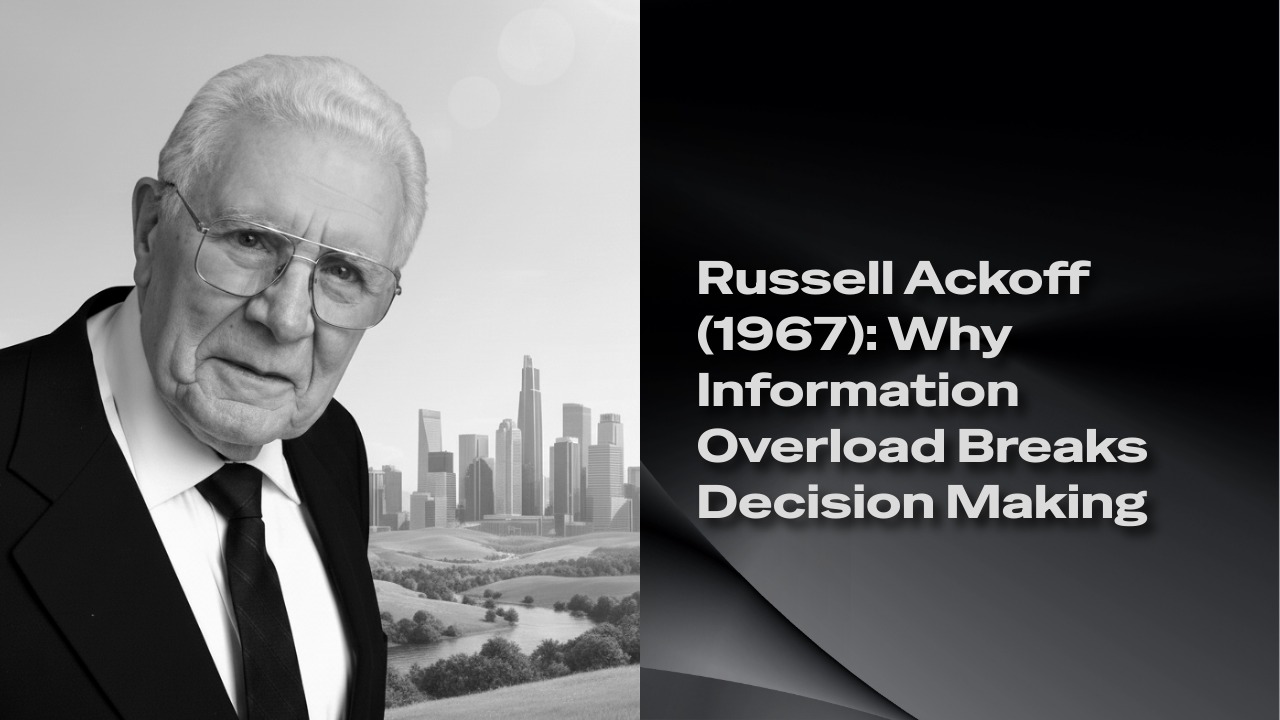
In 1967, long before the advent of big data, technologist Russell L. Ackoff argued that we weren’t building information systems at all; we were building misinformation systems. He identified five critical fallacies in their design that don’t just lead to bad dashboards, but to systems that actively confuse, mislead, and degrade organizational performance. His insights are more relevant today than ever, providing a powerful framework for understanding why so many of our data initiatives fail.
The Real Problem Isn’t a Lack of Information—It’s an Overload of Irrelevance
Ackoff’s primary argument is that most managers don’t suffer from a lack of relevant information, but from an overabundance of irrelevant information. To make his point, he shared his own experience in 1967 of receiving an average of 43 hours of unsolicited reading material each week. He cited seeing a daily stock status report of approximately 600 pages circulated to managers. This overload forces them to waste significant energy separating meaningful signals from overwhelming noise.
It seems to me that they suffer more from an over abundance of irrelevant information.
This insight perfectly describes the modern experience of “death by dashboard.” To prove the potential for improvement, Ackoff conducted an experiment where academic articles were condensed to one-third of their original length by simply eliminating words. When students were tested, their comprehension of the material was undiminished. The strategic imperative, then, is to invert the function of our information systems: their primary value is not in generation, but in aggressive filtration and condensation.
Managers Don’t Actually Know What Information They Need
Information systems are often designed by asking managers what they want to see. The fallacy here is the assumption that managers instinctively know what they need. Ackoff counters that for a manager to know what information is necessary, they must first have an adequate model of the decision they are making. This condition is rarely met. As he powerfully observed, “the less we understand a phenomenon, the more variables we require to explain it.”
He illustrated this with an anecdote from an oil company. Market researchers asked managers to identify variables for predicting service station sales, identifying almost seventy. The researchers then added about half again this many variables, ultimately finding thirty-five to be statistically significant in a regression model. Later, an Operations Research team built a superior model that predicted sales more accurately using only one variable: traffic flow. The managers, lacking a true model, played it “safe” by asking for “everything,” feeding the very misinformation system designed to help them.
Having the Right Information Doesn’t Guarantee the Right Decision
A common assumption is that if managers are given the needed information, their decision-making will automatically improve. Ackoff’s experience in operations research proved this false. For complex problems involving many variables or probabilities, like production scheduling or risk analysis, human intuition often fails, even when equipped with perfect information.
The human mind struggles to aggregate multiple probabilities or account for dozens of interdependent variables. The strategic insight here is that the role of the system must evolve from an information provider to a decision partner. An effective system shouldn’t just deliver raw data; it must also contain the logic—the decision rules, models, and simulations—to help humans overcome cognitive biases and navigate complexity.
More Communication Can Actually Make Things Worse
This is perhaps one of Ackoff’s most surprising insights. We instinctively believe that better communication between departments improves overall performance. Ackoff showed that when organizational units have conflicting goals, more information can be destructive.
He presented a caricature of a department store where the Purchasing department was measured on inventory turnover (keeping stock low) and the Merchandising department on gross sales (selling as much as possible). With perfect communication, Merchandising would optimistically request a large quantity of an item to avoid stock-outs. Purchasing, knowing this, would intentionally order less to protect its turnover metric. Seeing the smaller order, Merchandising would adjust its strategy, leading Purchasing to reduce its order again. This spiral of counter-productive adjustments, enabled by perfect communication, would ultimately result in nothing being bought or sold.
…when organizational units have inappropriate measures of performance which put them in conflict with each other, as is often the case, communication between them may hurt organizational performance, not help it.
The lesson is stark: organizational structure and incentives must be aligned before opening the floodgates of communication. Otherwise, our systems will only amplify dysfunction.
If You Can’t Evaluate Your System, You’re Being Controlled By It
System designers often try to make their tools “innocuous and unobtrusive,” assuring managers they only need to know how to use them, not how they work. Ackoff warned this is a dangerous trap. It leaves managers feeling incompetent to question the system, making them afraid to challenge the “black box.”
He recounted the story of a division that installed a computerized inventory system. A year later, it was found to be costing the company almost $150,000 per month more than the hand system which it had replaced. The cause was a simple, damning error: the program was confusing the maximum allowable stock level with the reorder point, causing it to reorder items that were already fully stocked. The error went unnoticed because managers felt unqualified to ask basic questions they would have easily asked of a manual process. Ackoff’s point is that managers must be trained to evaluate and control their information systems; otherwise, they unknowingly delegate control of the organization to the system’s designers.
Conclusion: Beyond the Dashboard
Ackoff’s 1967 analysis is a powerful indictment of how we still approach business intelligence. His work reveals that the ultimate antidote to Management Misinformation Systems is not better technology, but a fundamental shift in philosophy. The goal is not a better information system, but a better management control system, with information serving as just one component. Ackoff’s ultimate recommendation was that an MIS must be embedded in a management control system that models decisions, predicts outcomes, and learns from its errors.
These five fallacies are not historical footnotes; they are active design flaws in the BI and AI systems being deployed today. Before investing another dollar in a new dashboard or algorithm, we must first answer for these foundational sins.
As we race to build ever-smarter AI-driven systems, are we finally addressing these foundational problems, or are we just making the same 50-year-old mistakes at a faster speed?




Leave a Reply