




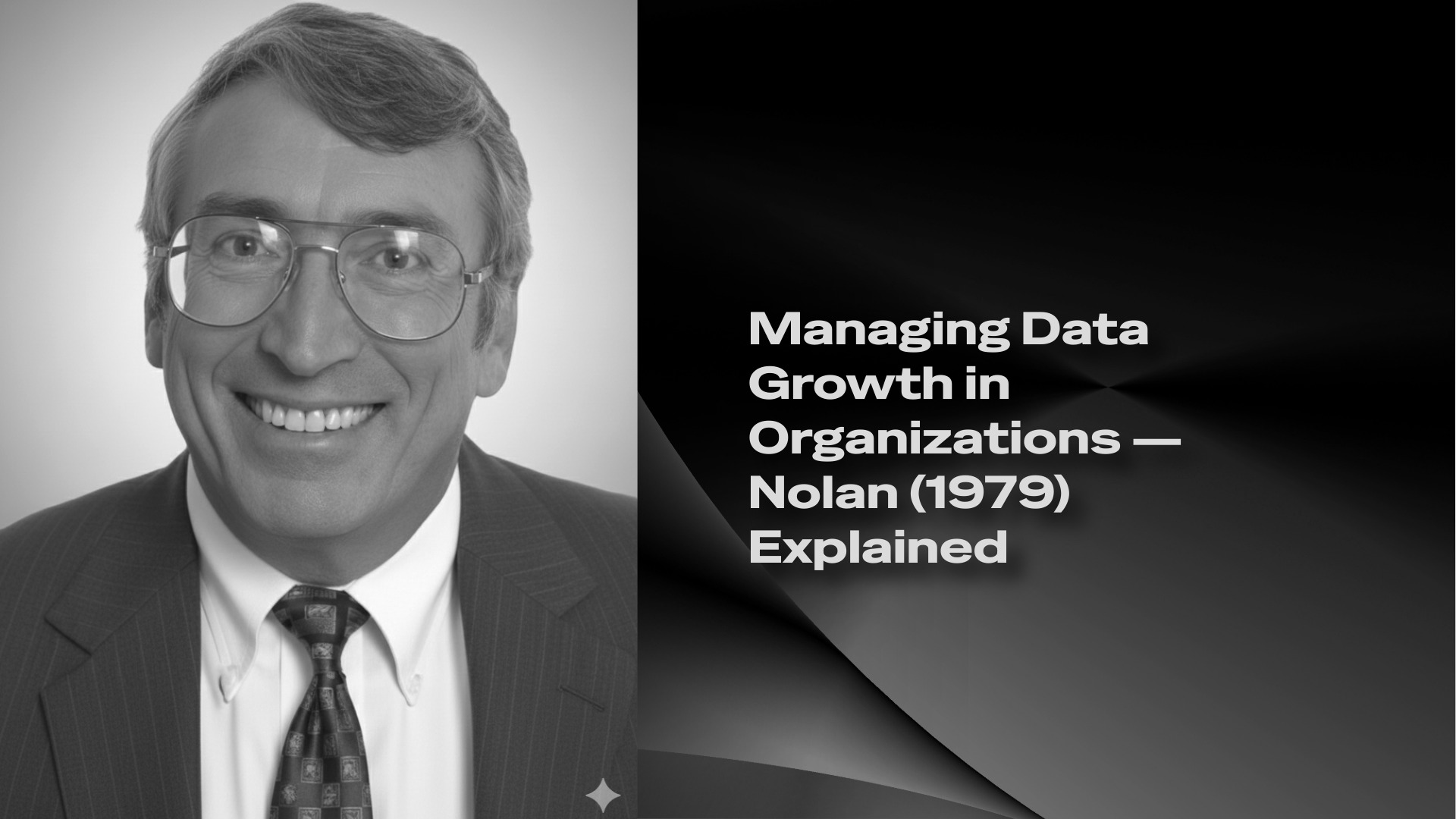
If you’re a manager, this scene might feel uncomfortably familiar. A vice president of information services, whose budget has ballooned from $30 million to over $70 million in just three years, admits, “I’m at the edge of control.” Technology is getting more complex, the right people are hard to find, and business leaders are demanding more, faster. This isn’t a scene from a board meeting last week; it’s from a Harvard Business Review article written in 1979.
Consider the context: This was written before the first Apple Macintosh was sold, when “the cloud” was in the sky, and “data” was stored on magnetic tapes. Yet, the organizational dynamics its author, Richard L. Nolan, described are playing out today in budget meetings about AI, cloud migration, and enterprise software. He argued that this seemingly chaotic growth isn’t random. It’s part of a predictable, six-stage evolutionary cycle. What Nolan called “data processing” or “DP” in 1979, we now call our entire technology stack and digital transformation effort. His decades-old insights provide a surprisingly relevant framework for understanding the budget crises and organizational friction many companies face today.
Your IT “Crisis” Isn’t Chaos, It’s a Predictable Cycle
The core concept from Nolan’s work is that a company’s technology function evolves through a predictable pattern of six stages. This provides a map for what often feels like uncharted territory.
The six stages are:
- Stage I: Initiation
- Stage II: Contagion
- Stage III: Control
- Stage IV: Integration
- Stage V: Data administration
- Stage VI: Maturity
The growth of tech expenditures through these stages follows an S-curve, not a straight line. This pattern, visually represented in Exhibit IV of Nolan’s original article, shows that the tech budget is not supposed to grow linearly. While spending often tracks sales growth in the early and late stages, it wildly exceeds it during the high-growth phases of Stage II (“Contagion”) and Stage IV (“Integration”). This is not a sign of failure, but a natural part of the cycle. This idea is impactful because it transforms reactive panic into proactive strategy. By understanding which stage your organization is in, you can anticipate what’s coming next and manage it more effectively.
To Fuel Innovation, You Have to Loosen Control
Nolan introduces a counter-intuitive balance between two environmental factors: “organizational slack” and “control.” “Control” describes a tight-budget, efficiency-focused environment. “Slack,” in contrast, is a looser environment where management commits more resources than are strictly necessary in order to nurture innovation and experimentation.
The key insight is that the ideal balance changes with each stage. To encourage widespread adoption and experimentation with a new technology, Stage II (“Contagion”) requires high slack and low control. This 1979 concept of “high slack” is the intellectual forerunner to today’s innovation labs, Google’s 20% time, R&D sandboxes, and agile development sprints. Nolan’s insight is that you cannot demand strict, Stage III ROI metrics from a Stage II exploratory phase without killing innovation. This is followed by Stage III (“Control”), where the organization must impose high control to professionalize the function and rein in the explosive growth of the previous stage. This argues against the conventional wisdom of maintaining strict budgetary discipline at all times.
User Frustration Is a Sign a Breakthrough Is Coming
During Stage III (“Control”), as the central IT department imposes formal controls, chargeback systems, and professional standards, a predictable thing happens: users become intensely frustrated. They see little progress on new systems while, as Nolan points out, they are “arbitrarily held accountable for the cost of DP support and have little ability to influence the costs.” For any modern manager who has been handed a surprise cloud services bill, this pain point is deeply relatable.
This frustration is a critical part of the process. The article notes:
…even the most stalwart users become highly frustrated and, in a familiar phrase, “give up on data processing.”
This period creates a massive “pent-up user demand.” When the IT department finally moves into Stage IV and begins delivering more reliable, high-quality services with new database technologies, this demand is unleashed. Users who had given up suddenly see real value and demand more, leading to another explosion in growth and investment. This reframes a period of intense organizational pain not as a failure, but as a necessary precursor to a major leap in capability and value.
You’re Probably Managing the Wrong Thing
Perhaps the most profound strategic shift described in the article is the transition from managing the computer to managing data resources. Nolan identified this critical shift decades before “data is the new oil” became a business cliché.
In the early stages, all planning and control systems are focused on the hardware. Executives are concerned with capacity planning, chargeback for computer services, and the operational efficiency of the machine itself. However, a critical “transition point” occurs around Stage III. The organization begins to realize that the true corporate asset isn’t the physical computer, but the information it processes. This forces a complete change in management emphasis. In the later stages, planning and control systems become data-oriented, focusing on data administration, shared data resources, and strategic data planning.
The failure Nolan warned about—getting stuck managing the cost of machines instead of the value of data—is the primary reason legacy companies are being outmaneuvered by data-native competitors today. The battle is still between managing compute costs versus creating value from information.
What Stage Is Your Company In?
The evolution of technology within an organization is a journey with predictable stages, challenges, and opportunities. Nolan’s framework shows that periods of explosive spending, user frustration, and strategic reorientation are not signs of chaos, but milestones on a path to maturity. Understanding this pattern provides leaders with the perspective needed to manage growth, set realistic budgets, and align user expectations with reality.
So, as you review your own budget, ask yourself: Is your tech spending truly “out of control,” or are you simply financing the necessary and predictable chaos of Stage II contagion or Stage IV integration? Nolan’s work suggests that understanding which stage you’re in is the first step to regaining control.




Leave a Reply